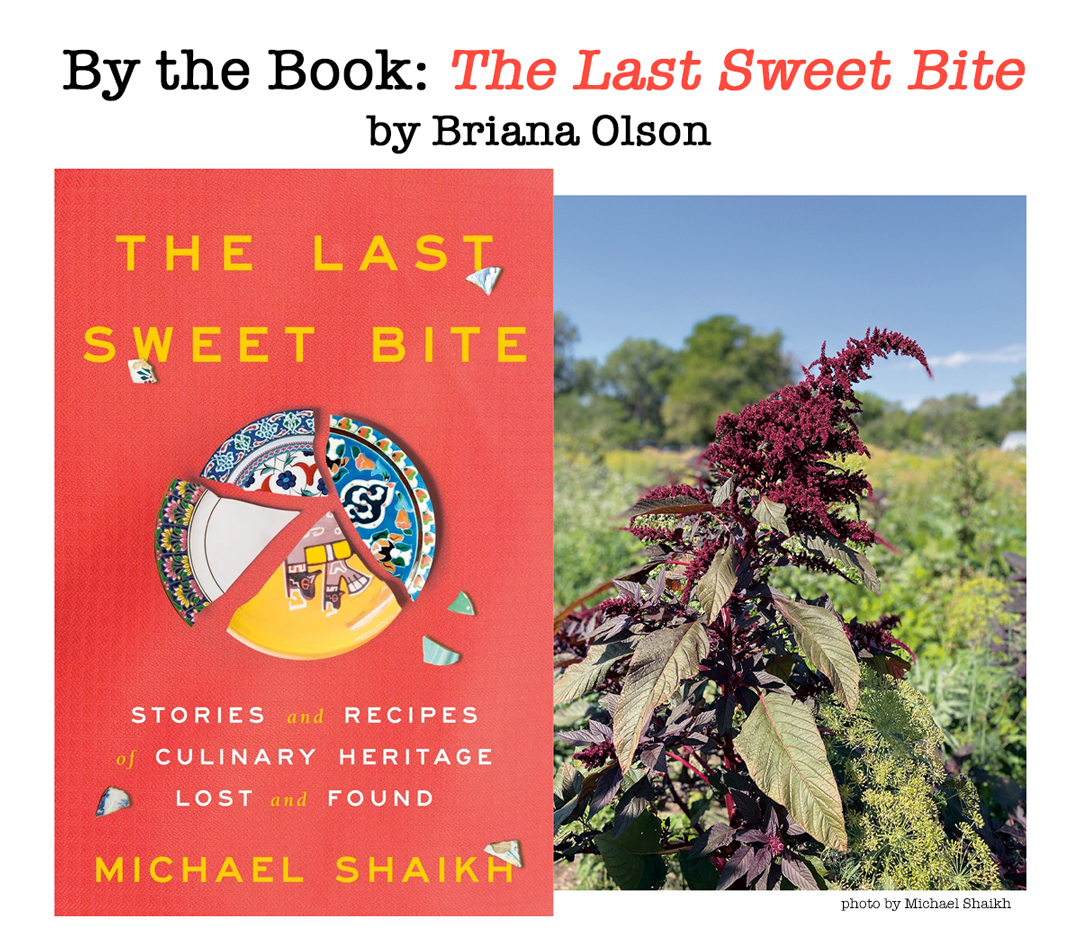
Early in The Last Sweet Bite, Michael Shaikh describes attending a dinner party in Kabul. He’s not surprised by the presence of cocktails, but he is surprised by the bowls of chickpea stew; despite having spent the past three years in Afghanistan and being, by his own account, a devoted eater, he had never tasted saland-e nakhod, nor even heard of the dish. “The wars have strangled Afghan culture,” the host of that dinner party later told him. “They have narrowed our language of food.”
In the food space, it is commonplace to uplift the melding of cultures in culinary traditions—a practice that, at best, can feel honorable and reverent and, at worst, can feel akin to shouting “Thanks for the seeds! These squash are great!” to the last surviving member of a tribe dying on a battlefield. What is often missing from the conversation is an honest reckoning with the violence that underpins so much of this cultural and culinary melding. We are drawn, perhaps, to make lemonade from lemons, to find beauty in the wake of bloodshed, to focus on the growth and gains gleaned from cultural exchange rather than on the irretrievable losses. To put it another way, who wants to be an eternal buzzkill? Isn’t this food? Can’t we just chill, and cook and eat and have some fun?
Given that Shaikh’s decade of work in human rights—which included, among other tasks, interviewing people about their experience being tortured—placed him directly within zones of conflict, it’s remarkable that his book, actually, is not a buzzkill. With The Last Sweet Bite, billed as a blend of memoir, travelogue, and cookbook, Shaikh makes an argument that, for this New Mexican, at least, is self evident: Cultural identity is carried through food, and to unravel a people, to strip a people of their cultural memory and thus their sense of self, conquerors and authoritarian regimes have long relied not only on the murder of civilians and the demolition of neighborhoods but on the suppression of language and traditions and the deliberate disruption of foodways.
Except—much of Shaikh’s reporting concerns the present tense. More than his central argument, I found the breadth of his case studies revelatory. From the lasting impacts of drab, Soviet-era efforts to “standardize” Czech cuisine to US-driven pressure to outlaw traditional uses of coca leaves in Bolivia, from the long-ago Spanish ban on amaranth to the Chinese Communist Party’s forcing imprisoned Uyghurs to eat pork, the author homes in on some of the most intimate aspects of regional conflicts so widely broadcast that we might make the mistake of thinking we understand them.

Kitchen in a Rohingya refugee camp in Bangladesh, photo by Ro Yassin Abdumonab.
Shaikh is not a culinary historian, and his purpose is not to trace the origins of every component of a dish or even of, for instance, Rohingya cuisine. Nor is his purpose to argue for the purity of a cuisine; purity, he surely knows, is for fascists. Besides, these stories are not strictly about food but rather about everyday people. Is there a touch of romance in some of these chapters, a dreaminess in his recounting of the days before Sri Lanka’s civil war, when Tamil women grew heirloom vegetables and ground their own rice flour? Maybe, but I think that’s the nature of memory. And if there are commonalities to these stories, one is the striving for autonomy implied by the simple choice of what to grow. Another is connecting to our ancestors through food. “For many Rohingya women like Maryam,” whose story Shaikh follows from her home village in Rakhine, Myanmar, to a refugee camp in Bangladesh, he writes, “cooking inside the camps is foremost a process of rebellion against forgetting.”
To make such claims without contributing to the preservation would be disingenuous, and so at the end of each chapter, Shaikh includes a small number of recipes. That does not quite make this a cookbook, and there’s at least one recipe that you won’t be able to make unless you know someone smuggling coca leaves into the United States. But, partly inspired by my own memory of witnessing the unbelievable expanse of the Mae La refugee camp in western Thailand, home to thousands (and generations) of displaced Karens, I made Maryam’s goru ghuso, or beef curry, and it was fiery and fabulous.

Only in his final chapters does Shaikh turn here, to North America and the centuries-old conquests of Hernan Cortés and Juan de Oñate. But as with the rest of his stories, his focus, in talking with New Mexico chef Ray Naranjo and his mother (and longtime activist) Marian Naranjo, is equally on the present and future. The backdrop of so many other contemporary peoples striving to sustain and restore their foodways brings fresh perspective to the story of the Pueblo Food Experience, an experiment in returning to a precontact diet guided by Roxanne Swentzell, as well as to Chef Ray’s approach to cooking, which is both about tapping into his ancestry and being free to pursue creativity.
This morning, standing in a dry riverbed in downtown Albuquerque, I reflected on the precarity of all our present-day foodways in the Southwest. How will the dismantling and downsizing of the Forest Service, the diminished federal protections of waters and species, the prospective sale of public lands impact the Rio Grande and the livelihoods and culinary traditions it supports? Who will write of us in the future, and will they be able, like Shaikh, to report on our resilience along with our losses?
Who’s Your Source?

Given the diversity of recipes in this book, there’s a single one-stop shop likely to have the majority of the specialty ingredients: Albuquerque’s Talin Market.
Bombay Spice, around the corner from Talin on Central, carries almost all the spices called for in the Tamil and Rohingya recipes, including both fresh and dried curry leaves (but not pandan leaf). They’ve also started carrying goat raised in northern New Mexico, but they didn’t have any on my recent visit, so call first.
In Santa Fe, the Savory Spice Shop carries high-quality dried spices, paired with friendly humans who can knowledgeably answer your questions. Online, Burlap & Barrel offers excellent paprikas (called for in the Czech recipes in Shaikh’s book) and, like Diaspora Co., prioritizes sourcing sustainably farmed and fairly traded spices. Once you’ve purchased outstanding turmeric, you’ll never go back to the stale, faded version that passes for it in many a spice jar.
For local beef, such as Shaikh says the Rohingya would have used in their homeplace, options include Keller’s Farm Stores and tiny grocer ABQ in Albuquerque, C4 Farms (pickups in Santa Fe and Albuquerque), Polk’s Folly in Cedar Crest, Beck & Bulow in Santa Fe, and your local farmers market. I found boneless short ribs from the Sweet Grass Cooperative at La Montañita Food Co-op in Nob Hill (they carry Sweet Grass’s beef at all their locations), and have purchased lovely goat, mutton, and lamb from Nizhoni Farms at the Downtown Growers’ Market in Albuquerque.

Briana Olson
Briana Olson is a writer and the editor of edible New Mexico and The Bite. She lives in Albuquerque.