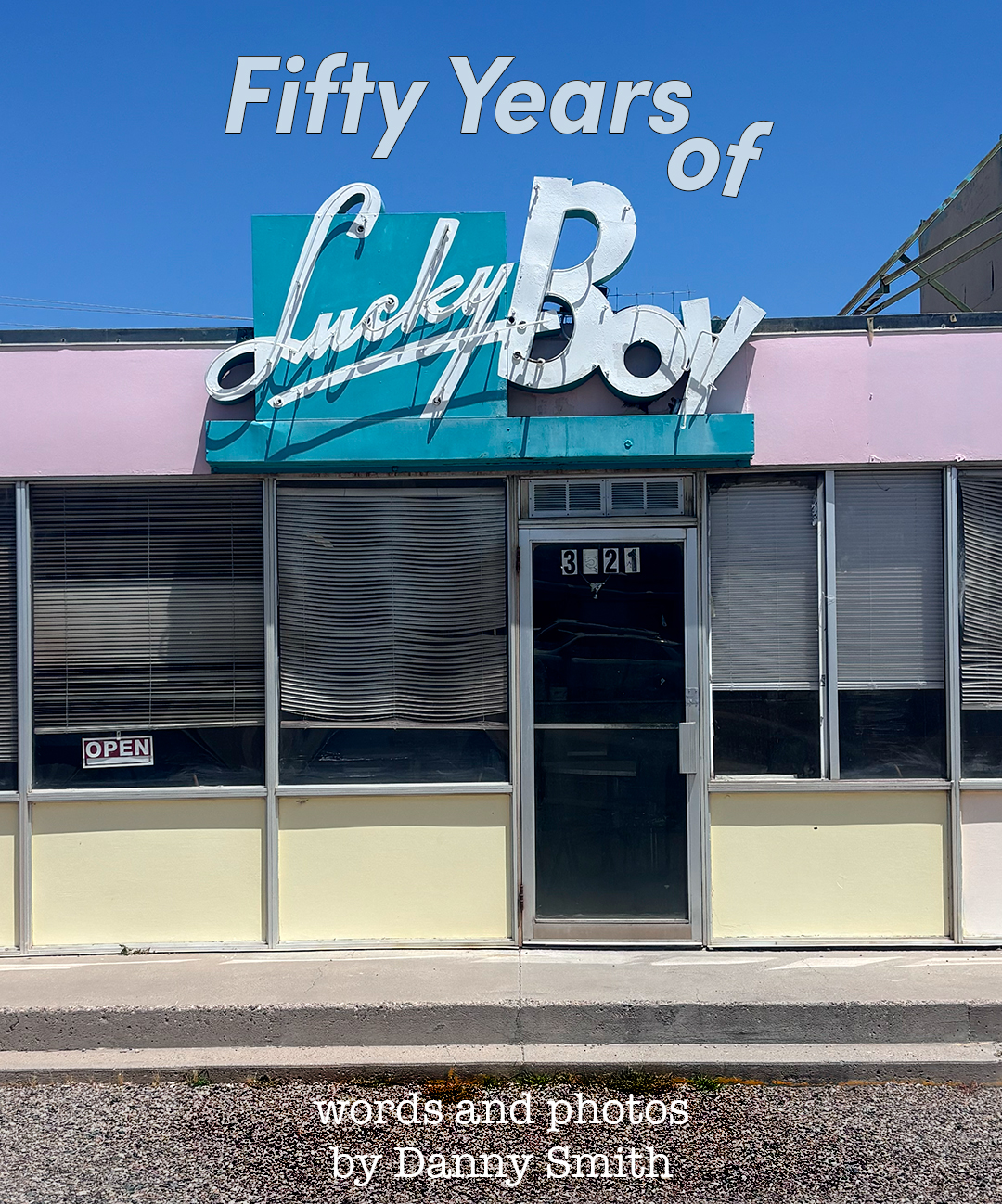
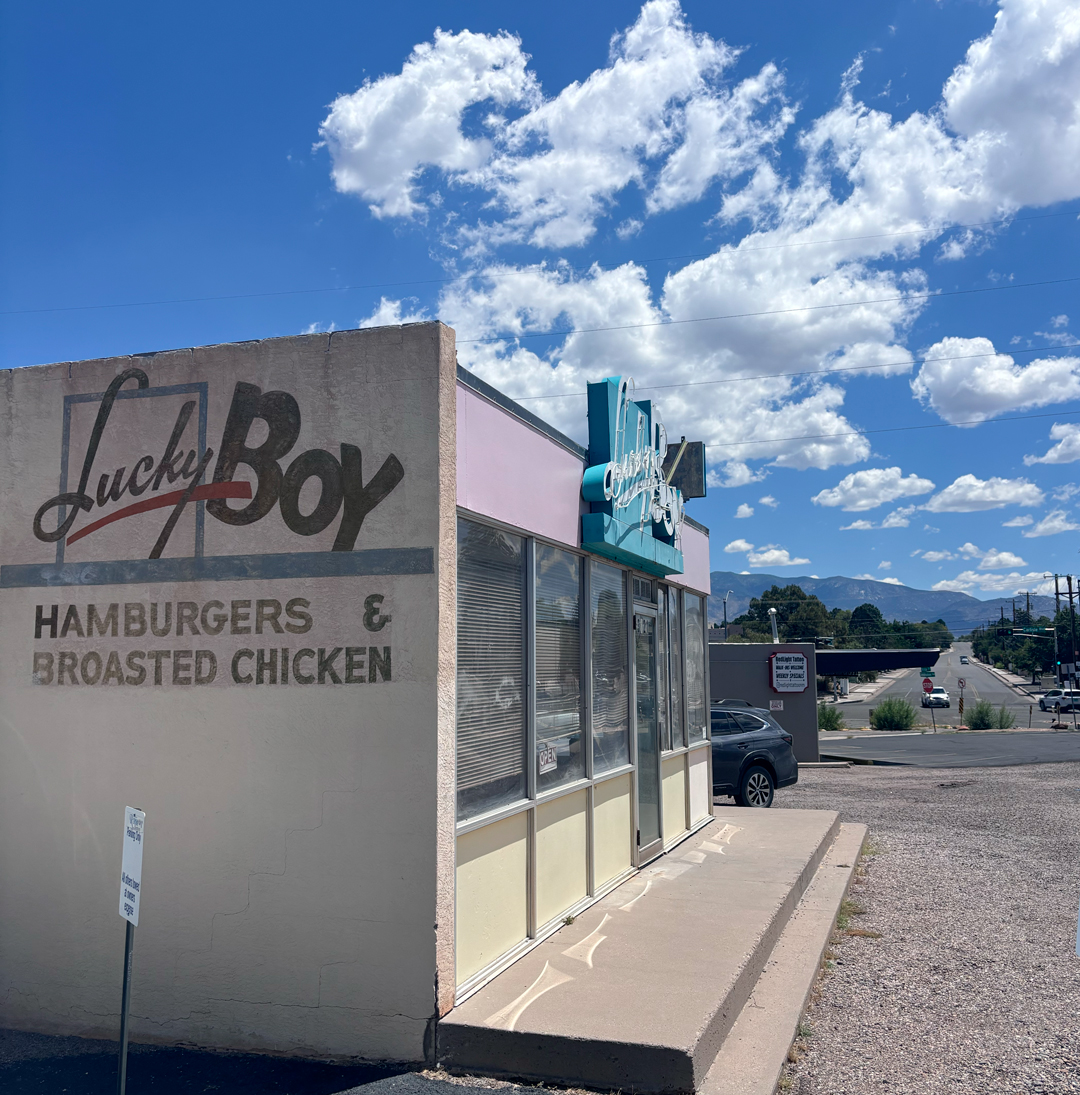
Over the past year, I’ve been working with Andy Burgess, an emeritus professor from the University of New Mexico’s philosophy department, to catalog, pack, and ship his personal library to various universities, scholars, and libraries around the world. One summer day in 2025, he suggested we take a break to head around the block for lunch at his favorite neighborhood establishment: Lucky Boy. I’d driven by Lucky Boy—located just west of Carlisle on Constitution—numerous times, but somehow never bothered to stop in. This in spite of the building’s standout architecture: It looks like a diner from the 1950s that hasn’t been touched, except, perhaps, to touch up the paint. A couple of visits later I discovered this to be true when one of the owners showed me a picture of the place taken sometime in the 1950s. The only notable difference was the makes and models of cars in the parking lot. To this day, the faded blue sign atop the humble building still advertises hamburgers, malts, and french fries. (A recent windstorm had knocked down an additional sign reading “Chinese Food & Hamburgers,” so I had yet to discover that this standard boardwalk-hamburger-stand fare is only half the story.)
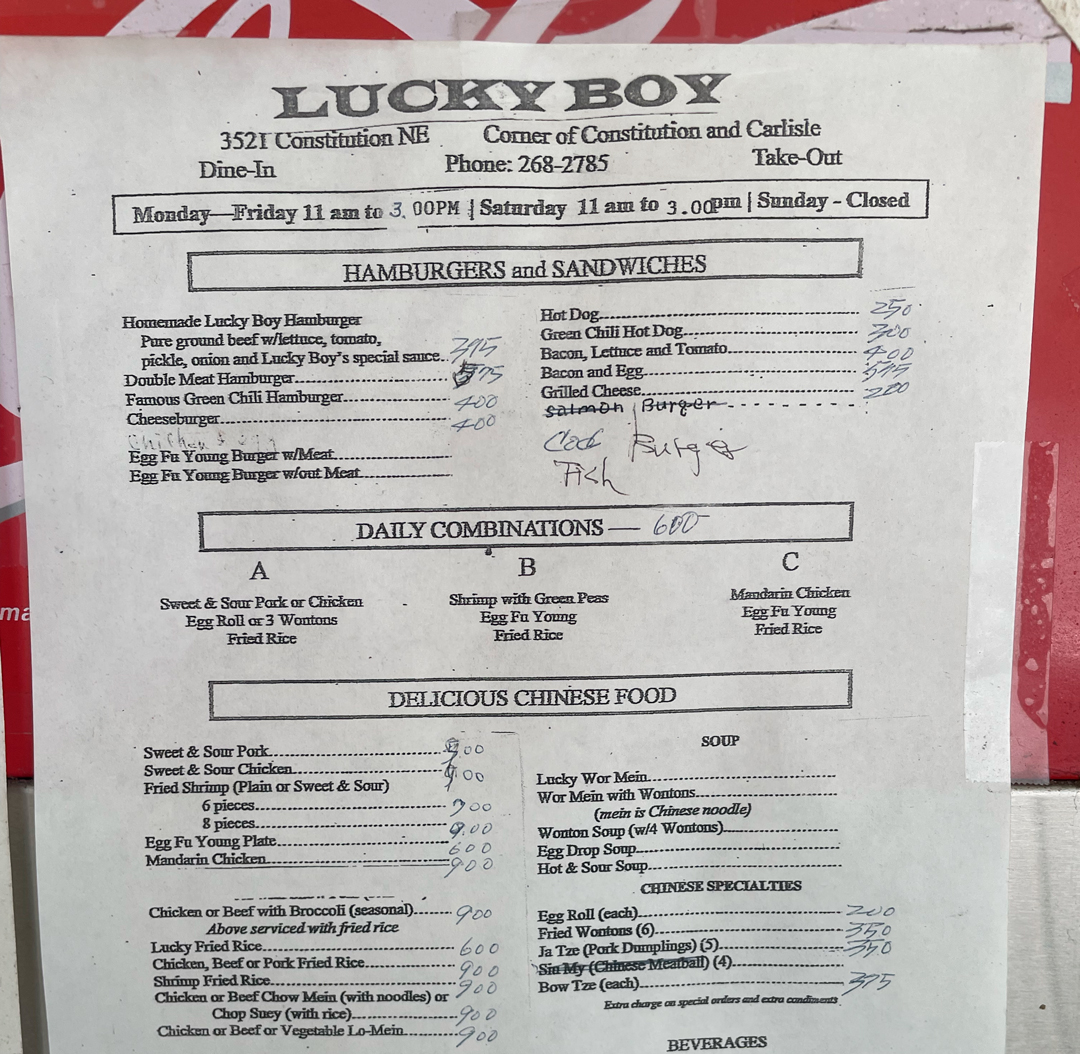
Before I had the chance to take a look at the paper menu taped to a vintage soda dispenser, the woman behind the counter greeted Andy by name and asked him how the book-relocating process had been going and how his wife, Jan, was doing. It was clear from her questions that she and Andy enjoyed a cordial and lasting bond. This was my first encounter with Susie Yip, Lucky Boy co-owner alongside her husband, Ronald Yip.
Susie and Ronald, Andy explained, would be celebrating fifty years of owning the restaurant in 2026. I later learned that they had bought the place from the original owners—a German couple who built it around 1951—and that, since its inception, this structure has borne the name “Lucky Boy.” Susie, who runs the counter and assists Ronald with the cooking, said that since taking over in 1976, she’s had many customers who first came in as children and remained regulars as they grew up to have their own children and grandchildren. Her evident delight in having, in effect, helped raise and nurture generations of local families with quality, inexpensive food added another layer to an atmosphere I was beginning to find increasingly inviting.
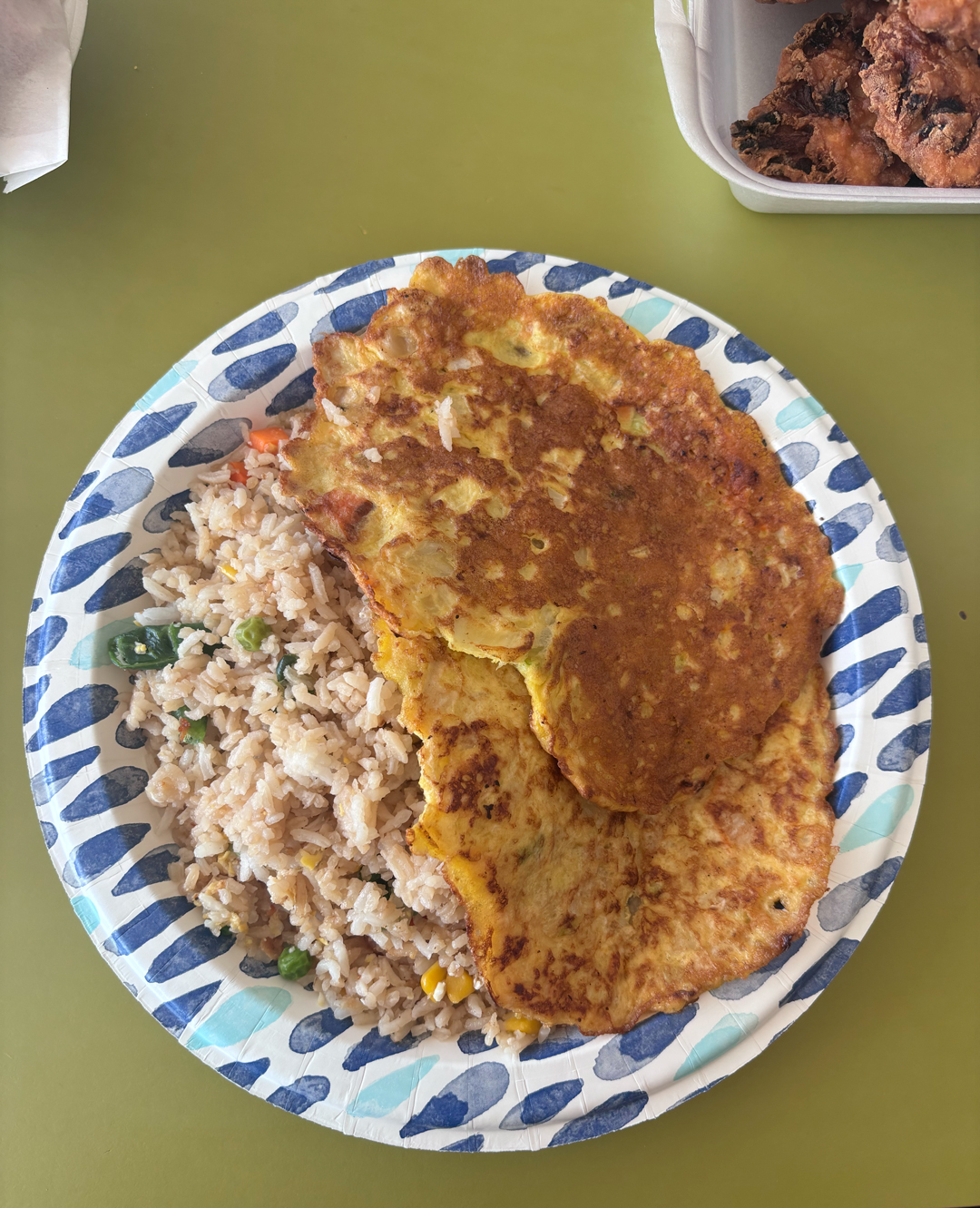
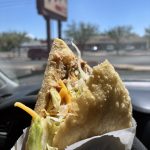
Glancing at the menu, I was, as a vegetarian, delighted to see a smattering of Chinese food options in addition to the burgers. Susie recommended the egg fu young plate, an egg-and-vegetable omelet served with vegetable fried rice. Andy ordered Lucky Boy’s signature dish, the egg fu young burger, which is exactly what it sounds like: a burger topped with egg fu young. It looked so good that on subsequent visits I took to ordering the egg fu young burger without meat. Housed in a sesame-seed bun, the egg fu young and regular burger fixings are augmented by a New Mexico classic: green chile and melted cheddar cheese. Mixed in with the gooey cheddar and bits of green chile are diced red and orange bell peppers and onions—a medley of textures and flavors that make the vegetarian version much more than a burger sans the meat.
When, in keeping with Lucky Boy’s cash-only policy, Andy pulled out a twenty-dollar bill to pay for our entire meal—plus a generous tip—I truly felt transported to a different time. Our food came out quickly, but we ate it slowly. We sat in a small booth chatting, the friendliness of the space, the comfort of food cooked with care, and the unwavering glare of the midday summer sun filtered by the blinds (which, I’m told, are original) all encouraging us to take small, meditative bites and indulge in easygoing conversation. After our meal, we deposited our utensils in a bucket located near the counter and were sent back out into the twenty-first century with a warm farewell from Susie and Ronald.
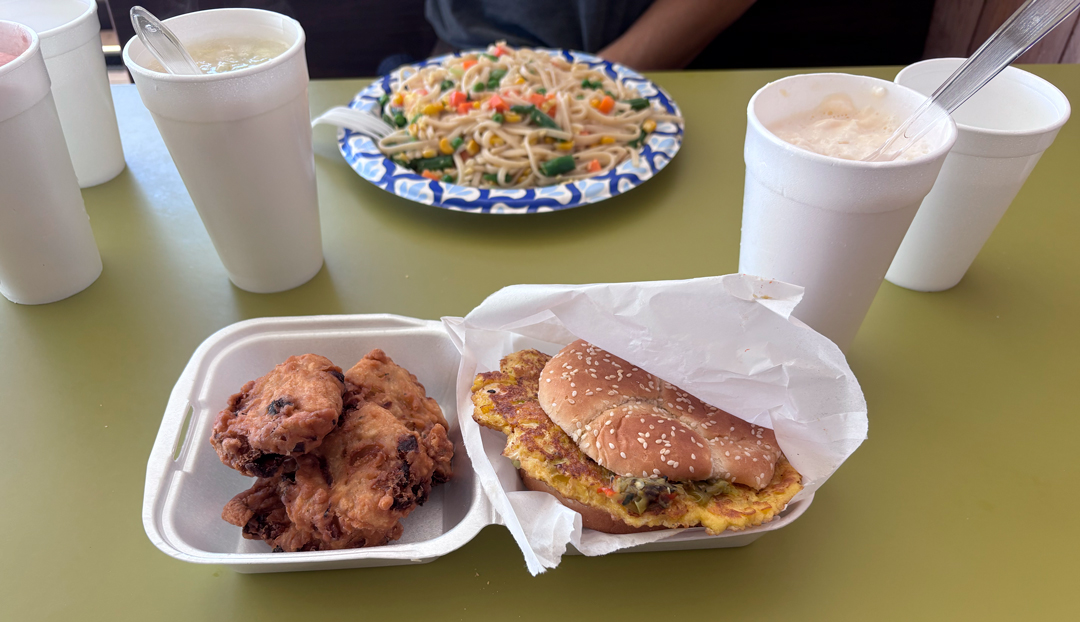
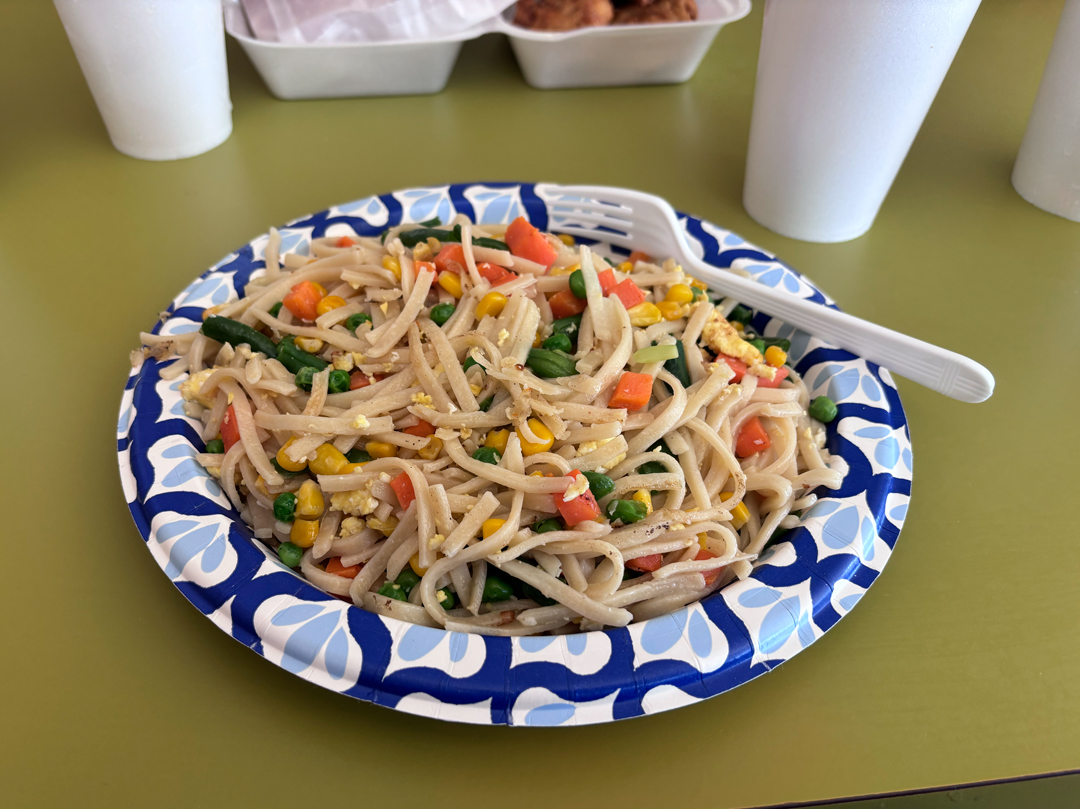
Already, I felt destined to become a regular. On one of my latest visits, another dining companion and I got vanilla and strawberry malts, veggie lo mein, egg-drop soup (served piping hot in a Styrofoam cup), a meatless egg fu young burger (of course), and onion cakes—bite-sized onion fritters that go just as well with ketchup as they do soy sauce. Again, the neighborly spirit of the establishment manifested in various small ways. For instance, Susie asked us if we’d like our malts kept in the freezer until we were done with our meals. We opted to take our dessert with the meal, which led my date to the inspired move of dipping an onion cake in her strawberry malt. Witnessing this, it occurred to me that this could only occur at a place like Lucky Boy. For it is precisely at beloved neighborhood establishments, sustained as much by the fostering of community as by consistent quality, that such delightfully simple experiments in cultural fusion—Chinese American fried onions meeting classic American shakes, Chinese spins on New Mexican spins on American diner food—can take place.
I’d argue that this is part of the importance of preserving long-standing local institutions like Lucky Boy. Even as Albuquerque has managed to honor and cultivate distinctively local culinary traditions, chain restaurants, here as throughout the United States, abound—such that Lucky Boy’s staying power is an achievement in and of itself. But I think the restaurant’s deeper triumphs go beyond that. To wit: On one visit, a customer beckoned me over after hearing me ask Susie some questions about the restaurant. Introducing himself as David Walker, he told me he’d been coming in since Ronald and Susie took over in the mid-1970s. After all these years, and even with David and his wife, Donna, now living out of state, Susie remembers David, whom she affectionately refers to as “Walker.” I heard from Andy that Susie even delivered him home-cooked food when he fell ill during the COVID closures.
In Lucky Boy, place, culture, and community coalesce to create something irreducibly unique and therefore irreplaceable. I felt in Lucky Boy not an attempt to cling to the past, but rather the multigenerational culinary and spiritual nourishing of genuine community, a nourishing that has provided both consistency and innovation over the past five decades, and which will hopefully continue for many more.
📍3521 Constitution NE, Albuquerque, 505-268-2785

Danny Smith
Danny Smith is a PhD student and instructor in the Department of Philosophy at UNM. He's interested in philosophy of language, philosophy of education, and the aesthetic traditions of the Southwest.