If “baking is love made edible,” as the popular saying goes, then each of the following pastries, handcrafted by artisan bakers across Santa Fe, spreads a little love with every bite. The origins of these unique treats span the globe, from Scandinavia to eastern Europe, from France to Spain to the Middle East, reflecting the diversity and range served up in Santa Fe bakeries. Savoring any of these international treats presents a timely opportunity to metaphorically cross borders and revel in the sweetness of foods that can bring us together.
A Swedish Staple

On the city outskirts of Old Las Vegas Highway, between vendors selling firewood and landscaping materials, people line up twice a week for fresh-baked baguettes, golden loaves of rye and wheat, and other beautiful baked goods, all piled high on a few folding tables. It was there that I recently discovered a cardamom-scented Swedish pastry that captured my heart, and not just because I was born in the country where it originated.
Kardemummabulle is an intricately twisted, fragrant and flavorful bun, aromatic with cinnamon and the floral notes of cardamom, often called the Queen of Spices. The brioche-like dough has a soft, fluffy texture, and the exterior is painted with a caramel glaze and dotted with pearl sugar, lending a sweetness, but not too much. In Sweden, kardemummabulle is an integral part of fika, the daily social coffee break.
“The cardamom bun is our classic pastry,” says Warren Peterson, baker and founder of the small but beloved Grain of the Desert. He mills his own flour, and since 2022 has been selling his coveted creations on Wednesdays and Saturdays on Old Las Vegas Highway. This summer, he’ll open a bakery on Montezuma Street in downtown Santa Fe. He bakes between seventy-two and one hundred kardemummabullar for the days he’s at the vendor’s lot and tends to sell out. “The folks who sell in the lot regularly come over to have a bun with their coffee,” he says. “There are Swedish people and people with Swedish families who are thrilled to find this here. The combination of the cinnamon and the cardamom is unparalleled.”
📍The vendor’s lot on Old Las Vegas Highway
A French Favorite

The French know a good thing when they taste it. They’ve enjoyed mille-feuille, a sensory delight layered with puff pastry and crème pâtissière, for at least two centuries. The classic pastry, also known as napoleon, is just one of many gorgeous French pastries displayed at Clafoutis in glass cases, like glittering gems. It’s also their bestseller. Mille-feuille translates as “a thousand leaves” and at Clafoutis, the sweet vanilla custard alternating between the many “leaves,” or layers, of flaky puff pastry, underscores the origin of the name.
With so many decadent choices at Clafoutis, what makes mille-feuille so popular? “It’s a textural thing,” says Marylou Ligier, whose parents opened the bakery and café in 2009 after moving to New Mexico from their native France, where their baking journey began. “You have the crispiness of the puff pastry, the smoothness of the vanilla custard, and the icing on top.” That icing takes the cake, decorating the top of the pastry with a traditional white-fondant-and-chocolate marbled design.
📍333 W Cordova, 505-988-1809
A Middle Eastern Delight

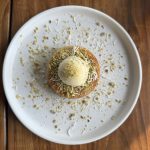
My first bite of basbousa, a beloved Arab treat served at Cafecito Santa Fe, transported me. The beguiling blend of ingredients—golden semolina, rose water, simple syrup, coconut, and pistachios—produced a nutty, vibrant flavor and, thanks to the semolina (milled from durum wheat), a comforting, rustic texture. The subtle essence of rose water was intoxicating.
While this dish is widely known as basbousa, it has many other names and variations, depending on the region. For Iranian American Neema Sadeghi, who is Cafecito’s chef and general manager (and was the owner/chef of the now-closed Milad Persian Bistro on Canyon Road), basbousa is familiar. “For me, the flavors are very nostalgic,” says Sadeghi, who was born to Iranian immigrants. “In a sense, it’s like home. I do like it with tea.” For customers at Cafecito, he sprinkles basbousa with coconut and local pistachios and tops it with vanilla ice cream.
Sitting in the Baca Railyard in the airy, light-filled restaurant that is known for its empanadas, I slowly savored this Ramadan staple and found myself dreaming of faraway lands.
📍922 Shoofly, Unit 101, 505-310-0089
A Latin Love

Some say churros were invented in early Spain as a portable snack for nomadic shepherds and named for their similar shape to the horns of Churra sheep. Others contend that they likely evolved from buñuelos and other fried-dough cousins of the region. Their charm, though, is indisputable, and as churros made their way through Latin America, different countries gave them unique twists. In Mexico, they’re almost always enrobed in cinnamon sugar, while in Chile and Argentina, they might be filled with dulce de leche.
Santa Fe’s place for tantalizing takes on the fried-dough treat is Churro Bar, a friendly, festive spot devoted, as the name suggests, to the artistry of churros. Flights of three made-to-order churros are assembled like a work of art. Of the three I tried, my favorite, the Frida Kahlo, was filled with creamy dulce de leche and topped with raspberries, blackberries, and pecans.
“The churro is one of the most popular desserts around the globe,” says Churro Bar owner Gerardo García. “I had the idea to make something different and elevated, giving it the spot it deserves instead of being all greasy in the paper bag.” García’s churros are so outrageous that the Food Network chose his churro cake for its list of over-the-top treats in every state. Says García, “My idea is for people to take a bite and say this is the best churro I’ve had in my life.”
📍102 E Water, 505-920-4682
A Slice of Hungarian Heaven

Dolina Cafe & Bakery feels like a cozy European coffeehouse. Friends catch up over fragrant cups of coffee and apple walnut strudel, while solo diners scan the daily paper as they feast on kapustnica, a Slovakian soup full of sauerkraut, mushrooms, and prunes. Before taking a seat, patrons walk by a glass case brimming with temptation, from tvaroh pockets (eastern European turnovers) to Polish tea cookies to Mexican wedding cakes to Meyer lemon tarts. I’m here for makos dios, a delightfully dark and dense cake whose main ingredients are ground poppy seeds and walnuts. The dessert originated in Hungary, and Dolina’s gluten-free version is topped with a layer of raspberry jam, providing just the right amount of sweetness, and crushed walnuts.
“Poppy seeds are very earthy,” says Dolina baker and owner Annamaria Brezna O’Brien, who grew up in a small Slovakian spa town. “They have a little taste of bitterness. Not everyone likes poppy seeds, but for me it’s a taste of home.” Makos dios may be Hungarian, but it’s crafted with what Brezna O’Brien describes as the most-used ingredients in her homeland. “Walnuts and poppy seeds are the backbone of Slovakian baking,” she says. “Food doesn’t really have borders, so what we make in Slovakia is very much used in Hungarian and Austrian baking. We make strudel, they make strudel.” Once you taste makos dios, you’ll be grateful that this Slovakian baker is making this Hungarian dessert in Santa Fe.
📍402 N Guadalupe, 505-982-9394

Lynn Cline
Lynn Cline is the award-winning author of The Maverick Cookbook: Iconic Recipes and Tales From New Mexico. She’s written for Bon Appétit, the New York Times, New Mexico Magazine, and many other publications. She also hosts Cline’s Corner, a weekly talk show on public radio’s KSFR 101.1 FM.