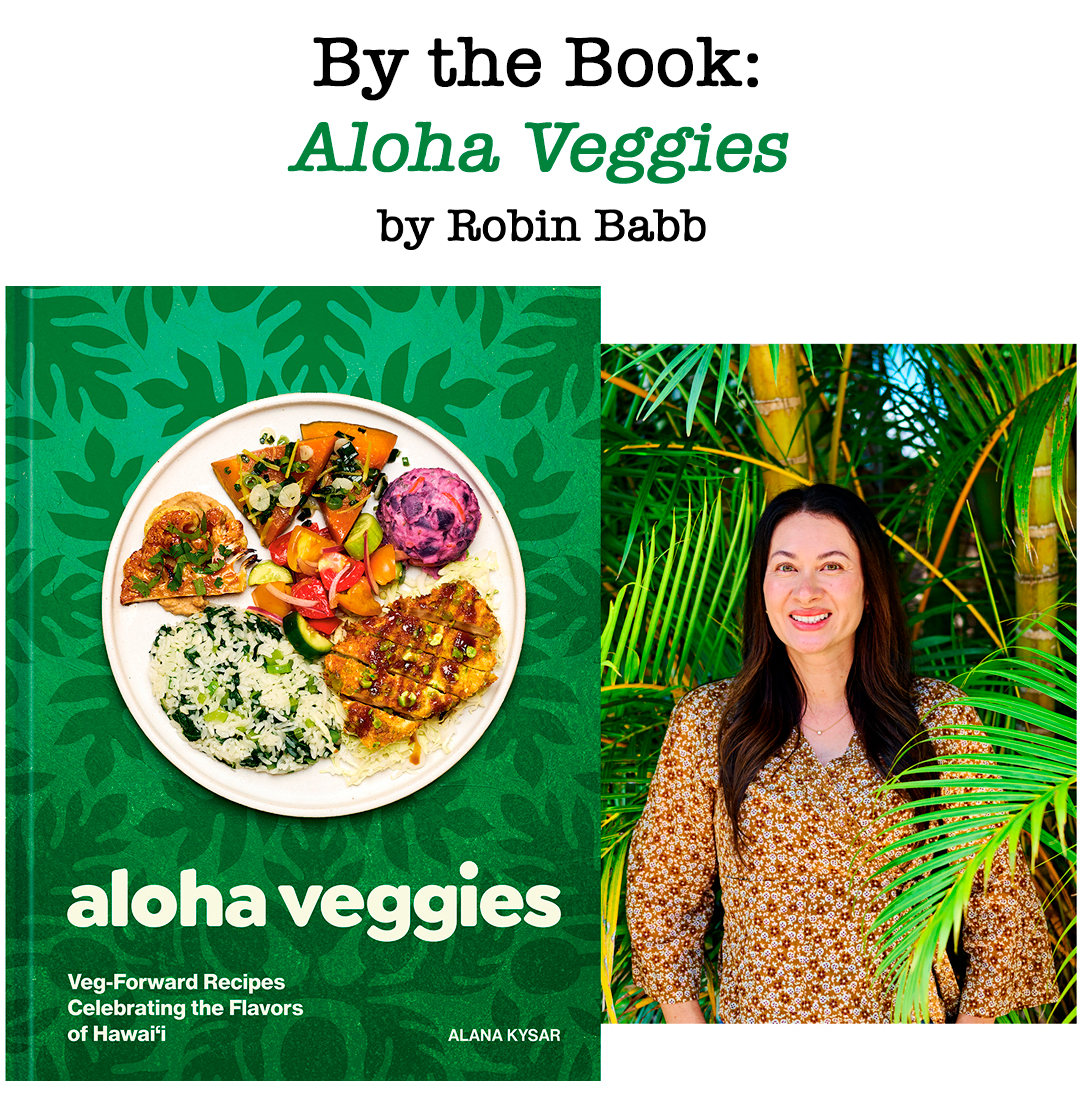
Aloha Veggies: Veg-Forward Recipes Celebrating the Flavors of Hawai‘i
by Alana Kysar
If you’ve been to Hawai‘i or even just eaten at a Hawaiian restaurant stateside, it’s likely that your primary conception of the modern local cuisine is the classic plate lunch: main (usually a protein, like barbecue chicken or kalua pork), starch (most often white rice), and side (macaroni salad is the typical one). It’s not exactly the most vegetable-forward formula—not the healthiest, either. But, as Alana Kysar reports in the intro to her forthcoming cookbook Aloha Veggies: Veg-Forward Recipes Celebrating the Flavors of Hawai‘i, things are changing, and the islands have experienced something of a culinary and agricultural rebirth in recent years. After HC&S, the largest sugarcane producer in Hawai‘i, ended operations in 2016, over thirty-six thousand acres of agricultural land were freed up to grow other crops; then, COVID-19 and the devastating 2023 fires on Maui prompted an even greater desire to grow more produce on the islands, rather than relying on imports for most food.
These are just some of the reasons that Kysar, who grew up on Maui and returned to live there in 2022, embarked on her project to craft more veg-forward modern Hawaiian dishes, while still sticking to the main-starch-side formula of the typical plate lunch. Though not vegan or vegetarian herself, she finds that many of the techniques and seasonings of local Hawaiian cooking are just as suited for vegetables as for meat, if not more so: “Vegetables are so diverse—much more than meat, in textures, tastes, and so on—that making them taste good is easy. When you pick the right vegetable for the dish, you will be amazed by what you can create.” It’s true: In the recipes for braises and stews that fill the pages of the “Mains” section in Aloha Veggies, you’ll find that cabbage and squash hold up well to long cook times, and that mushrooms and Japanese eggplant have excellent textures when fried in mochiko, the sweet rice flour adopted from Japanese cuisine.
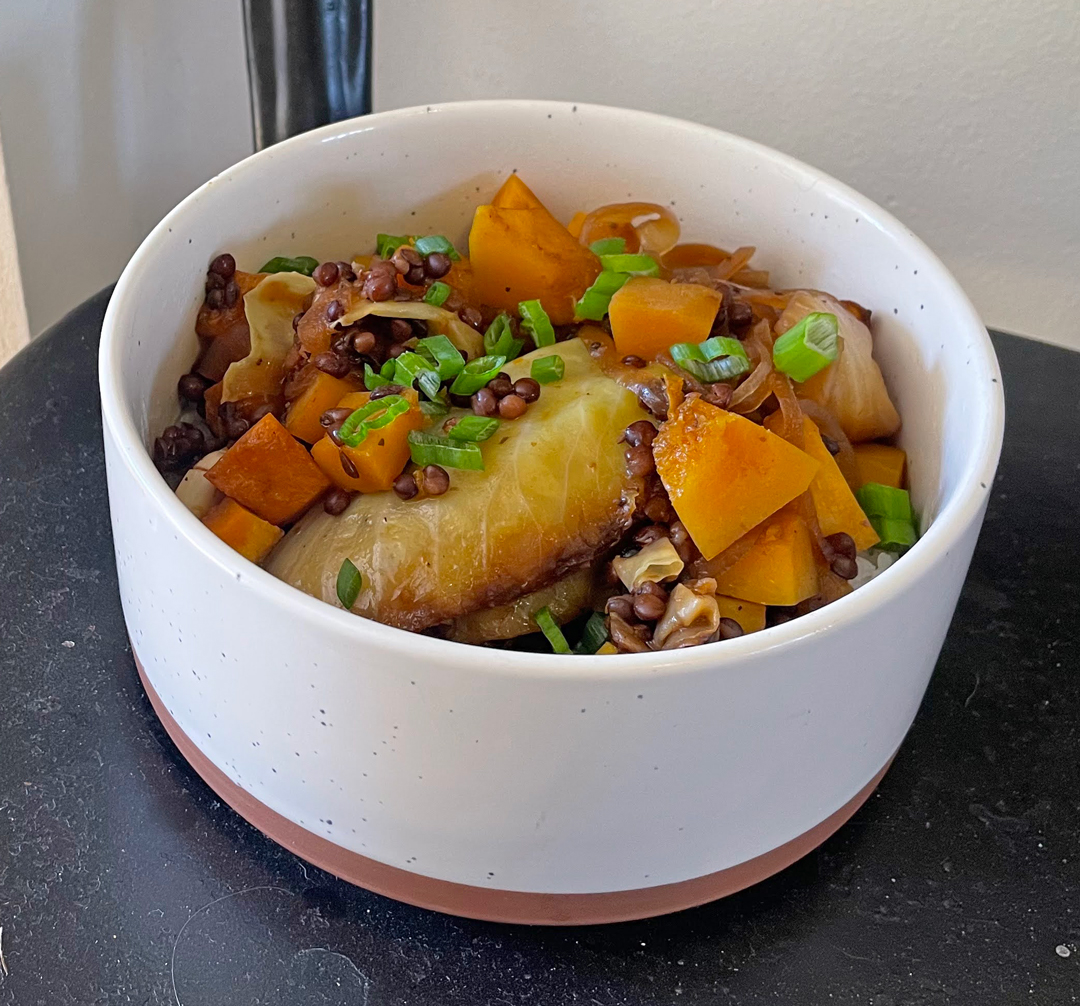
After spending a few days with the book, I announced to a friend coming over for dinner that “I’m going to adobo everything now.” The Cabbage Adobo with Butternut Squash and Black Lentils was what hooked me first: the savoriness of the cabbage with adobo seasoning, plus the heartiness and texture provided by the lentils and squash. After that, I found myself making adobo cabbage on its own regularly, and then turning a weeknight dinner that was originally supposed to be a curry into an adobo stew instead. As Kysar says in the intro, “Doing [a technique] several times sets you up to find more combos and preparations that speak to you. Finding different ways to capture the essence of food memory or flavor sets you up to cook more veggies.”
From adobo to shoyu to jun, the cookbook is structured around base recipes that Kysar encourages you to use and reuse to your heart’s content. These recipes get spun into many permutations that I’d never have thought of, like Shoyu Cauliflower with Chickpeas—a dish that’s incredibly comforting and filling on its own, and even more so paired with a starch and side from their respective chapters in the book.
These are not elaborate, multiday recipes that commit to tradition at the expense of convenience—Hawaiian food is thoroughly modern and global, and Kysar’s not a purist with using only native-grown Hawaiian ingredients or methods in her cooking (which would be especially limiting on an island). Most dishes come together in less than an hour, and any prep work involved is explained in a way that makes you instantly feel licensed to use the same techniques elsewhere in your cooking arsenal, whether Hawaiian or not. That license to experiment is no doubt furthered by the fact that Hawaiian cuisine is so much the product of the melding of various cuisines that it inevitably earns the moniker fusion cooking. I delighted in cooking my way through Aloha Veggies, and have found several new heavy-rotation meals in its pages. I suspect you will too.
Who’s Your Source
There are a few ingredients in Aloha Veggies that might prove a bit difficult to find in New Mexico—for instance, the Hawaiian laulau is traditionally wrapped in taro and ti leaves while it cooks, neither of which I was able to find locally. However, Kysar always offers a substitution for ingredients like these, and collards or Swiss chard do the trick in this case.
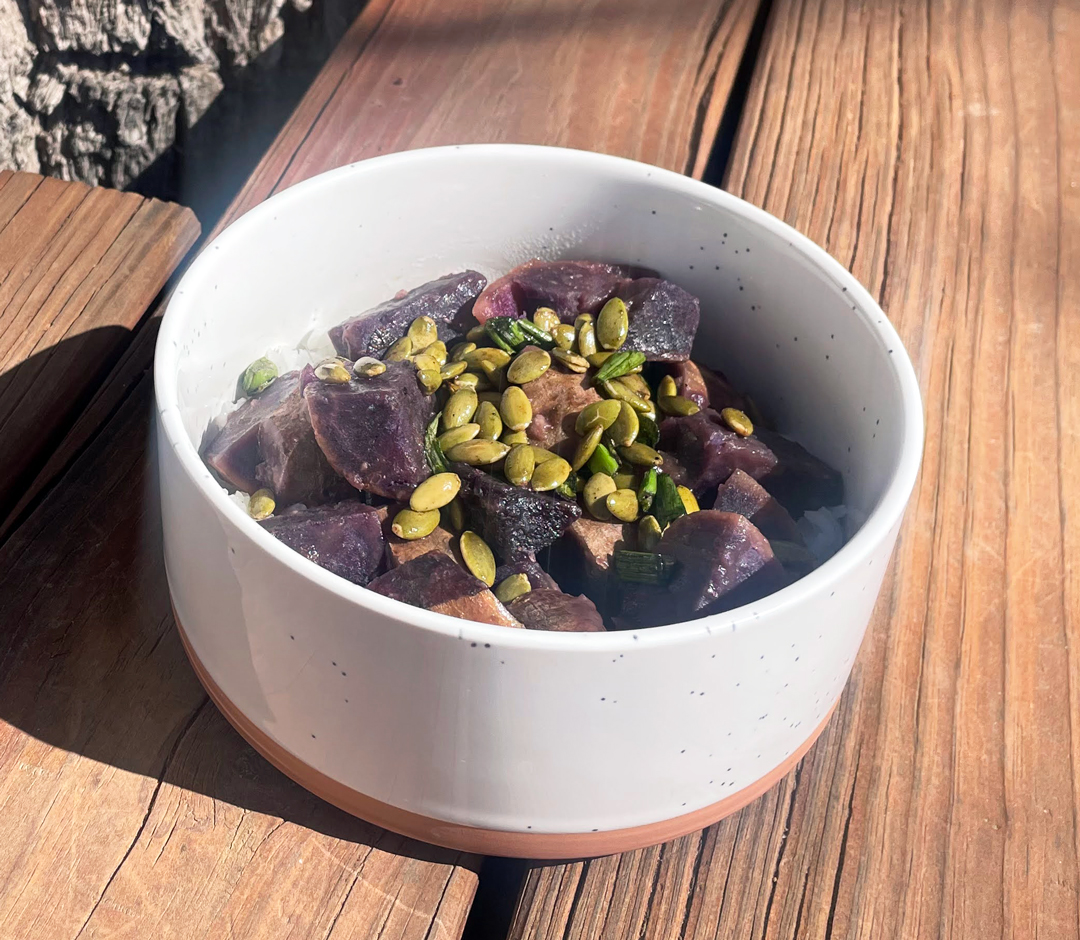
As Kysar says, “Hawai‘i’s local food culture was built by and primarily influenced by the three major diasporas that ended up in Hawai‘i, so it encompasses Hawaiian dishes like poi, made from baked and pounded taro, as well as hearty braised meats, stews, and stir-fries from Chinese, Japanese, Portuguese, Korean, and Filipino settlers.” Because of these influences, Santa Fe Asian Market and Talin Market in Albuquerque are good sources for specialty ingredients like mochiko. Talin also carries a variety of Asian produce including taro root and Okinawan sweet potatoes, a specific kind of starchy, deeply purple-hued sweet potato that would be just as well-suited to a dessert as to the sides that Kysar makes from them: a super-simple Coconut Sweet Potato Mash and Roasted Miso Sweet Potato with Pumpkin Seeds, which provides a beautiful balance of crunchy, salty pumpkin seeds and pillowy-soft potatoes.
Robin Babb
Robin Babb is the associate editor of edible New Mexico and The Bite. She is an MFA student in creative writing at the University of New Mexico and lives in Albuquerque with a cat named Chicken and a dog named Birdie.